
Why Is Gold Price Falling After Hitting Record Highs? 5 Key Reasons Explained..
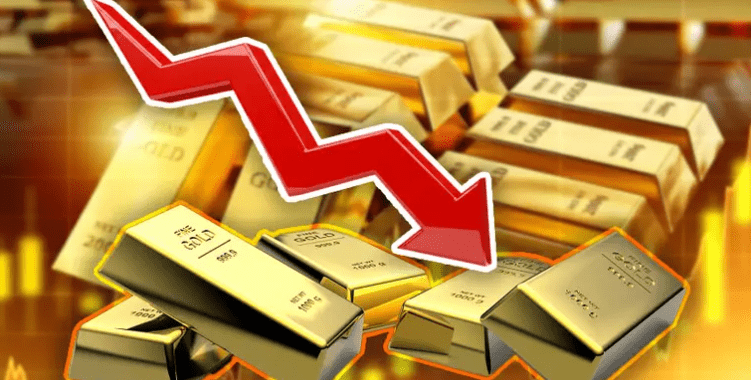
Last year and in early 2026, gold prices in the global market shattered every previous record to reach an all-time high. But recently, that rally has hit a significant reversal. Spot gold, after touching the historic peak of $5,500 per ounce, went through a major correction — falling nearly 28% and approaching the psychological support zone near $4,000.
In my earlier article, I discussed why gold prices keep rising. But as forex and commodity traders, the biggest question on our minds now is: why did gold suddenly enter this extended decline? Let’s break down the main reasons behind it, in the context of the global economy.
1. Strong Rally in the US Dollar Index (DXY) and Bond Yields
One of the golden rules of the forex market is the inverse relationship between the US dollar and gold prices. As the US Dollar Index (DXY) strengthened recently, gold became significantly more expensive for international buyers. At the same time, rising US Treasury bond yields pushed large institutional investors to sell gold and move toward bonds instead. Since gold doesn’t offer any regular dividend or interest income, bonds naturally become more attractive whenever interest rates are high.
2. The Fed’s “Higher for Longer” Interest Rate Policy
Earlier this year, markets expected the US Federal Reserve to cut interest rates quickly. But due to a resilient labor market and inflation that hasn’t fully cooled, the Fed backed away from rate cuts and signaled it would keep rates higher for longer. This tighter monetary policy created significant downward pressure on gold, a non-yielding asset.
3. Profit-Taking by Large Investors
In any financial market, a correction is natural once an asset becomes overextended. After gold delivered returns of more than 70% over the past year and a half, institutional investors and hedge funds began heavily taking profits to lock in gains. This wave of selling pressure increased market liquidity and drove prices down rapidly.
4. Easing Geopolitical Tensions
Gold is often called a “safe haven” asset. During wars, political crises, or global uncertainty, people flock to gold. Recently, diplomatic efforts between the US and Iran — particularly around the Strait of Hormuz — along with a general easing of global tensions, brought a “risk-on” mood back to the markets. Investors started moving away from safe-haven assets and back into equities and other higher-yielding but riskier sectors.
5. Central Banks Slowing Down Their Gold Purchases
One of the key drivers behind gold’s meteoric rise in recent years was the record pace of gold accumulation by central banks — especially China and India. However, according to recent quarterly data, as gold prices climbed too high, central banks slowed down their aggressive buying, which directly affected overall demand for gold.
Impact on the Bangladeshi Market
The ripple effect of this global correction reached our local market as well. The Bangladesh Jewellers Association (BAJUS) adjusted local gold prices downward several times in line with the international market. Back in January this year, the price of 22-karat gold per bhori had climbed to a record BDT 286,000, but it has since come down in stages, making it somewhat more accessible for regular buyers.
The Recent FOMC Meeting and a New Turn for Gold
The US Federal Reserve’s FOMC meeting held on July 28-29 brought a fresh turning point for the gold market. Fed Chairman Kevin Warsh announced that interest rates would remain unchanged this time, which caused the US Dollar Index and Treasury bill yields to drop noticeably. As a result, gold broke out of its prolonged downtrend and rose nearly 2% within just 24 hours, touching the psychological resistance zone of $4,100 again.
In my view, while the Fed’s decision has created some short-term uncertainty in the markets, it’s acting as a strong bullish catalyst for gold.
When Could Gold Start Rising Strongly Again?
According to recent forecasts from market analysts and J.P. Morgan Global Research, gold could be gearing up to break its previous all-time high (above $5,600) by late 2026 or early 2027. I believe two main factors will drive this next leg up:
- A possible rate cut in September or November: If the Fed makes an official announcement to cut interest rates in the coming months, gold could kick off its real bull run.
- A resurgence of geopolitical instability: Any fresh geopolitical turmoil or signs of a global economic slowdown in the Middle East or elsewhere would send safe-haven demand for gold sharply higher overnight.
Final Thoughts: A Long-Term Slump or a Temporary Opportunity?
According to market analysts, this decline in gold isn’t a permanent downturn — it’s a natural correction within a longer-term bull market. Major financial institutions like J.P. Morgan and the World Gold Council are forecasting that if global economic uncertainty picks up again toward the end of 2026, gold could reclaim its earlier highs and go on to set new records over the long run.
As a long-term forex and commodity investor, my advice is to keep a close eye on the current $4,000 support zone and the post-FOMC rebound — this could turn out to be an excellent buying opportunity.
Add a Comment
You must be logged in to post a comment